 Add to Chrome
 Add to Firefox
 Add to Edge
Deformable Gaussian Occupancy: Decoupling Rigid and Nonrigid Motion with Factorized Distillation
May 27, 2026
Understanding dynamic 3D environments is essential for safe autonomous driving, particularly when reasoning about human-centric, nonrigid agents. However, existing weakly supervised occupancy prediction frameworks predominantly assume rigid-body motion and rely on simple frame-to-frame offsets, limiting their ability to capture fine-grained deformations and maintain temporal coherence. To address this issue, we propose DeGO, a deformable Gaussian occupancy framework that unifies decoupled Gaussian deformation with factorized 4D foundation-model distillation. DeGO disentangles rigid and nonrigid motion, enabling each Gaussian primitive to evolve through both deformation and offset-based updates. In parallel, a factorized 4D distillation strategy transfers cross-camera and cross-frame knowledge from the VGGT foundation model, producing foundation-aligned features that enhance temporal consistency. Experiments on the Occ3D-NuScenes benchmark demonstrate that our method achieves state-of-the-art performance under weak supervision, delivering 13.5% gains on human-centric instances and 10.9% overall improvements. These results highlight the effectiveness of deformation-aware and foundation-guided occupancy modeling for dynamic scene understanding. The code is publicly available: https://github.com/vita-epfl/DeGO

Proprio: Latent Self-Scoring and Inference-Time Refinement for Physically Plausible Video Generation
May 27, 2026Modern video generative models produce visually impressive results, yet frequently violate basic physical principles. We propose Proprio, a training-free framework that enables a frozen video generator to assess and improve the physical plausibility of its own outputs. Inspired by proprioception, the biological sense of one's own movement, Proprio treats the model's flow residual under controlled latent perturbations as a self-scoring signal. Samples that are better explained by the generator's learned dynamics induce smaller and more stable residuals. We aggregate this signal across timesteps and perturbations, focus it on motion-relevant regions with a dynamic spatiotemporal mask, and use it for best-of-N search, gradient-based self-refinement, or both. Across text-to-video and image-to-video benchmarks, Proprio consistently improves physical plausibility, outperforming VLM-based scoring, and external world-model baselines in several settings. With TurboWan2.2, Proprio improves Physics-IQ from 32.2 to 37.5 (+16.5%) and VideoPhy2-hard physical commonsense from 45.6 to 55.0 (+20.6%). Human evaluation further shows that raters prefer Proprio-selected or refined videos for physical plausibility in roughly two-thirds of comparisons. These results suggest that frozen video generators contain actionable internal signals for evaluating and improving the physical plausibility of their own outputs.
Drift-Resistant Navigation World Model with Anchored Epipolar Guidance
May 23, 2026We propose Drift-Resistant Navigation World Model, a generative model that mitigates both perceptual drift and geometric drift in conventional rollout-based navigation world models. Existing methods recursively feed generated content into subsequent steps, causing noise accumulation and degraded predictions, i.e., perceptual drift. Meanwhile, their predictions often deviate from the agent's motion, resulting in geometry drift. We address both types of drift by redesigning world-model prediction as an anchor-guided rollout. Instead of rolling out every frame sequentially, we first predict sparse future anchors that serve as stable long-range targets, and then generate intermediate frames within each chunk conditioned on both past context and future anchors. Importantly, these sparse anchors also provide geometric constraints, supported by bidirectional epipolar geometry, to localize where corresponding content should appear in the intermediate frames. Experiments on four benchmarks demonstrate consistent improvements over strong baselines in long-horizon visual quality, geometric consistency, and multi-view coherence. These gains further translate into improved downstream planning performance under the same planners, highlighting the importance of drift-resistant, geometry-aware prediction for reliable navigation world models.
EverAnimate: Minute-Scale Human Animation via Latent Flow Restoration
May 14, 2026We propose EverAnimate, an efficient post-training method for long-horizon animated video generation that preserves visual quality and character identity. Long-form animation remains challenging because highly dynamic human motion must be synthesized against relatively static environments, making chunk-based generation prone to accumulated drift: (i) low-level quality drift, such as progressive degradation of static backgrounds, and (ii) high-level semantic drift, such as inconsistent character identity and view-dependent attributes. To address this issue, EverAnimate restores drifted flow trajectories by anchoring generation to a persistent latent context memory, consisting of two complementary mechanisms. (i) Persistent Latent Propagation maintains a context memory across chunks to propagate identity and motion in latent space while mitigating temporal forgetting. (ii) Restorative Flow Matching introduces an implicit restoration objective during sampling through velocity adjustment, improving within-chunk fidelity. With only lightweight LoRA tuning, EverAnimate outperforms state-of-the-art long-animation methods in both short- and long-horizon settings: at 10 seconds, it improves PSNR/SSIM by 8%/7% and reduces LPIPS/FID by 22%/11%; at 90 seconds, the gains increase to 15%/15% and 32%/27%, respectively.
Grounded World Model for Semantically Generalizable Planning
Apr 13, 2026In Model Predictive Control (MPC), world models predict the future outcomes of various action proposals, which are then scored to guide the selection of the optimal action. For visuomotor MPC, the score function is a distance metric between a predicted image and a goal image, measured in the latent space of a pretrained vision encoder like DINO and JEPA. However, it is challenging to obtain the goal image in advance of the task execution, particularly in new environments. Additionally, conveying the goal through an image offers limited interactivity compared with natural language. In this work, we propose to learn a Grounded World Model (GWM) in a vision-language-aligned latent space. As a result, each proposed action is scored based on how close its future outcome is to the task instruction, reflected by the similarity of embeddings. This approach transforms the visuomotor MPC to a VLA that surpasses VLM-based VLAs in semantic generalization. On the proposed WISER benchmark, GWM-MPC achieves a 87% success rate on the test set comprising 288 tasks that feature unseen visual signals and referring expressions, yet remain solvable with motions demonstrated during training. In contrast, traditional VLAs achieve an average success rate of 22%, even though they overfit the training set with a 90% success rate.
Harnessing Lightweight Transformer with Contextual Synergic Enhancement for Efficient 3D Medical Image Segmentation
Mar 24, 2026Transformers have shown remarkable performance in 3D medical image segmentation, but their high computational requirements and need for large amounts of labeled data limit their applicability. To address these challenges, we consider two crucial aspects: model efficiency and data efficiency. Specifically, we propose Light-UNETR, a lightweight transformer designed to achieve model efficiency. Light-UNETR features a Lightweight Dimension Reductive Attention (LIDR) module, which reduces spatial and channel dimensions while capturing both global and local features via multi-branch attention. Additionally, we introduce a Compact Gated Linear Unit (CGLU) to selectively control channel interaction with minimal parameters. Furthermore, we introduce a Contextual Synergic Enhancement (CSE) learning strategy, which aims to boost the data efficiency of Transformers. It first leverages the extrinsic contextual information to support the learning of unlabeled data with Attention-Guided Replacement, then applies Spatial Masking Consistency that utilizes intrinsic contextual information to enhance the spatial context reasoning for unlabeled data. Extensive experiments on various benchmarks demonstrate the superiority of our approach in both performance and efficiency. For example, with only 10% labeled data on the Left Atrial Segmentation dataset, our method surpasses BCP by 1.43% Jaccard while drastically reducing the FLOPs by 90.8% and parameters by 85.8%. Code is released at https://github.com/CUHK-AIM-Group/Light-UNETR.
PreferRec: Learning and Transferring Pareto Preferences for Multi-objective Re-ranking
Mar 23, 2026Multi-objective re-ranking has become a critical component of modern multi-stage recommender systems, as it tasked to balance multiple conflicting objectives such as accuracy, diversity, and fairness. Existing multi-objective re-ranking methods typically optimize aggregate objectives at the item level using static or handcrafted preference weights. This design overlooks that users inherently exhibit Pareto-optimal preferences at the intent level, reflecting personalized trade-offs among objectives rather than fixed weight combinations. Moreover, most approaches treat re-ranking task for each user as an isolated problem, and repeatedly learn the preferences from scratch. Such a paradigm not only incurs high computational cost, but also ignores the fact that users often share similar preference trade-off structures across objectives. Inspired by the existence of homogeneous multi-objective optimization spaces where Pareto-optimal patterns are transferable, we propose PreferRec, a novel framework that explicitly models and transfers Pareto preferences across users. Specifically, PreferRec is built upon three tightly coupled components: Preference-Aware Pareto Learning aims to capture user intrinsic trade-offs among multiple conflicting objectives at the intent level. By learning Pareto preference representations from re-ranking populations, this component explicitly models how users prioritize different objectives under diverse contexts. Knowledge-Guided Transfer facilitates efficient cross-user knowledge transfer by distilling shared optimization patterns across homogeneous optimization spaces. The transferred knowledge is then used to guide solution selection and personalized re-ranking, biasing the optimization process toward high-quality regions of the Pareto front while preserving user-specific preference characteristics.
Factorized Video Generation: Decoupling Scene Construction and Temporal Synthesis in Text-to-Video Diffusion Models
Dec 18, 2025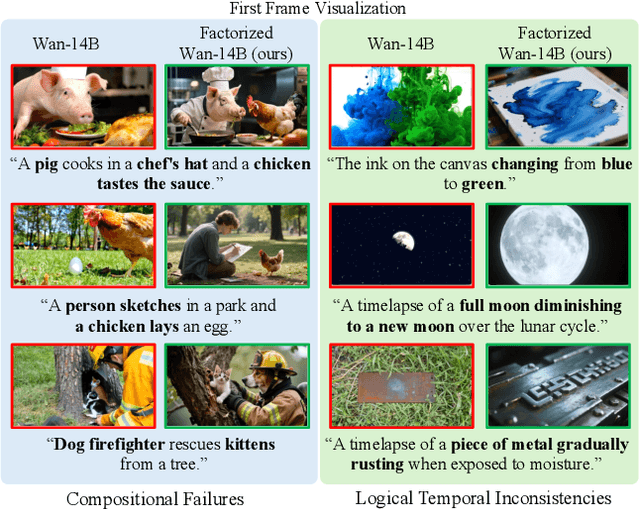
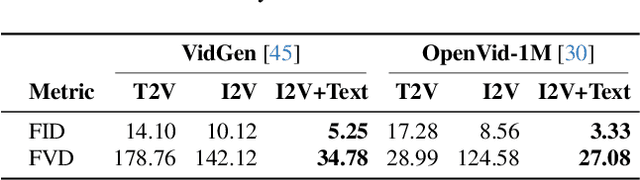
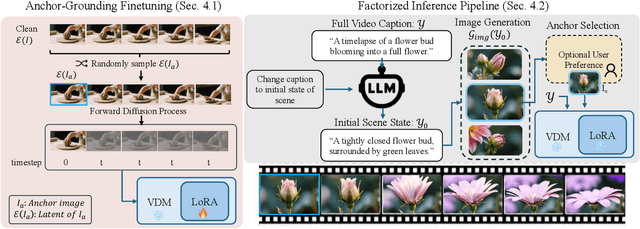
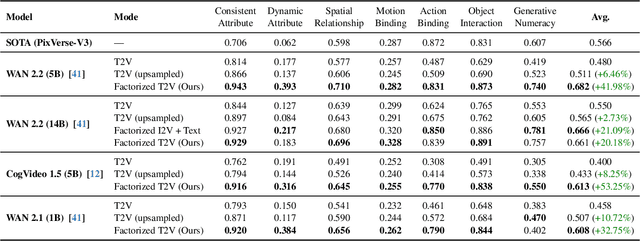
State-of-the-art Text-to-Video (T2V) diffusion models can generate visually impressive results, yet they still frequently fail to compose complex scenes or follow logical temporal instructions. In this paper, we argue that many errors, including apparent motion failures, originate from the model's inability to construct a semantically correct or logically consistent initial frame. We introduce Factorized Video Generation (FVG), a pipeline that decouples these tasks by decomposing the Text-to-Video generation into three specialized stages: (1) Reasoning, where a Large Language Model (LLM) rewrites the video prompt to describe only the initial scene, resolving temporal ambiguities; (2) Composition, where a Text-to-Image (T2I) model synthesizes a high-quality, compositionally-correct anchor frame from this new prompt; and (3) Temporal Synthesis, where a video model, finetuned to understand this anchor, focuses its entire capacity on animating the scene and following the prompt. Our decomposed approach sets a new state-of-the-art on the T2V CompBench benchmark and significantly improves all tested models on VBench2. Furthermore, we show that visual anchoring allows us to cut the number of sampling steps by 70% without any loss in performance, leading to a substantial speed-up in sampling. Factorized Video Generation offers a simple yet practical path toward more efficient, robust, and controllable video synthesis
RAP: 3D Rasterization Augmented End-to-End Planning
Oct 05, 2025Imitation learning for end-to-end driving trains policies only on expert demonstrations. Once deployed in a closed loop, such policies lack recovery data: small mistakes cannot be corrected and quickly compound into failures. A promising direction is to generate alternative viewpoints and trajectories beyond the logged path. Prior work explores photorealistic digital twins via neural rendering or game engines, but these methods are prohibitively slow and costly, and thus mainly used for evaluation. In this work, we argue that photorealism is unnecessary for training end-to-end planners. What matters is semantic fidelity and scalability: driving depends on geometry and dynamics, not textures or lighting. Motivated by this, we propose 3D Rasterization, which replaces costly rendering with lightweight rasterization of annotated primitives, enabling augmentations such as counterfactual recovery maneuvers and cross-agent view synthesis. To transfer these synthetic views effectively to real-world deployment, we introduce a Raster-to-Real feature-space alignment that bridges the sim-to-real gap. Together, these components form Rasterization Augmented Planning (RAP), a scalable data augmentation pipeline for planning. RAP achieves state-of-the-art closed-loop robustness and long-tail generalization, ranking first on four major benchmarks: NAVSIM v1/v2, Waymo Open Dataset Vision-based E2E Driving, and Bench2Drive. Our results show that lightweight rasterization with feature alignment suffices to scale E2E training, offering a practical alternative to photorealistic rendering. Project page: https://alan-lanfeng.github.io/RAP/.
See&Trek: Training-Free Spatial Prompting for Multimodal Large Language Model
Sep 19, 2025We introduce SEE&TREK, the first training-free prompting framework tailored to enhance the spatial understanding of Multimodal Large Language Models (MLLMS) under vision-only constraints. While prior efforts have incorporated modalities like depth or point clouds to improve spatial reasoning, purely visualspatial understanding remains underexplored. SEE&TREK addresses this gap by focusing on two core principles: increasing visual diversity and motion reconstruction. For visual diversity, we conduct Maximum Semantic Richness Sampling, which employs an off-the-shell perception model to extract semantically rich keyframes that capture scene structure. For motion reconstruction, we simulate visual trajectories and encode relative spatial positions into keyframes to preserve both spatial relations and temporal coherence. Our method is training&GPU-free, requiring only a single forward pass, and can be seamlessly integrated into existing MLLM'S. Extensive experiments on the VSI-B ENCH and STI-B ENCH show that S EE &T REK consistently boosts various MLLM S performance across diverse spatial reasoning tasks with the most +3.5% improvement, offering a promising path toward stronger spatial intelligence.